
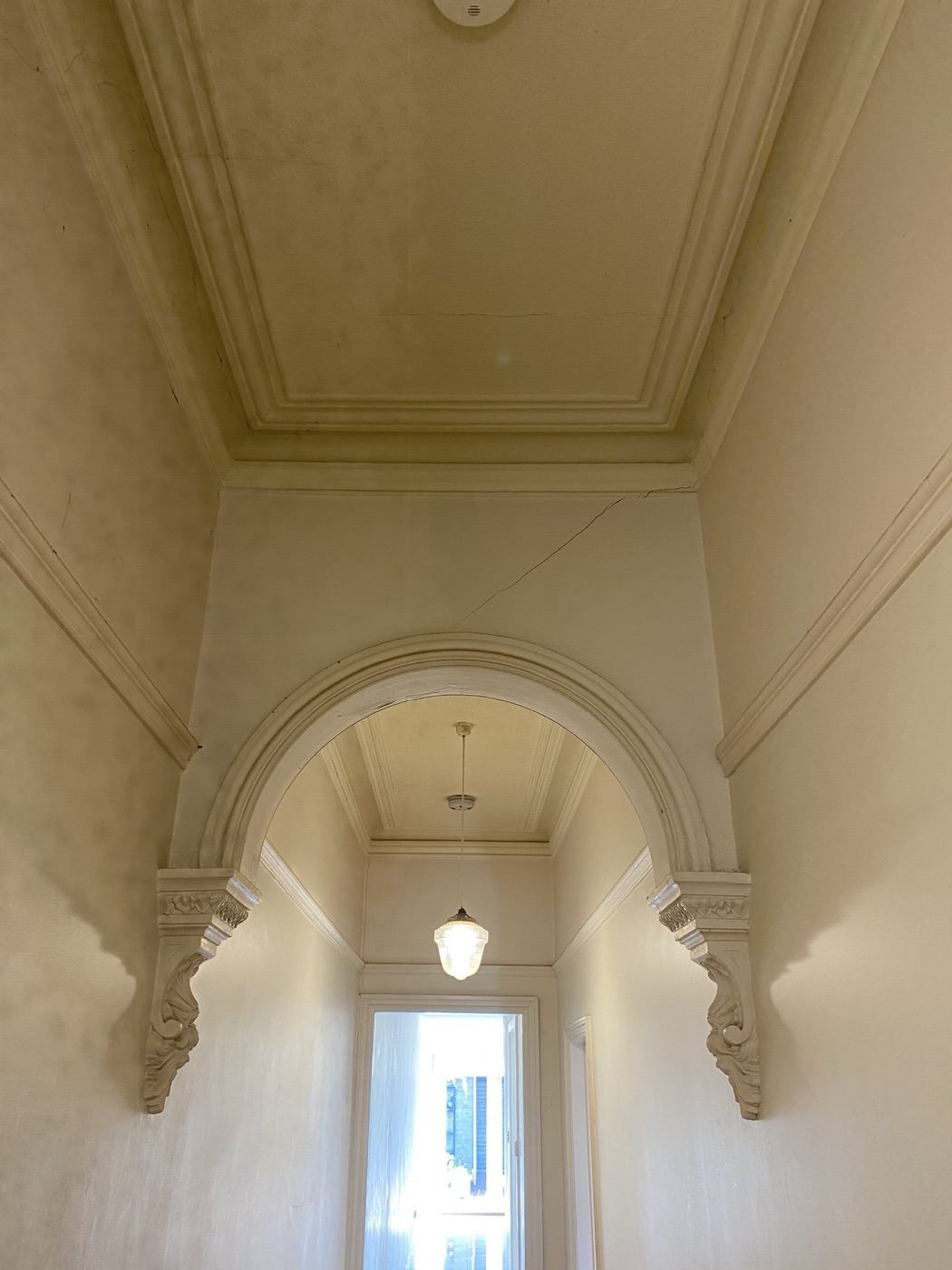
Restoring Period Detail in an Older Melbourne Hallway
Original arches, deep cornices, picture rails and timber architraves are exactly what give an older Melbourne home its character — and they're also the details most likely to get quietly ripped out and replaced with something generic the first time a hallway needs work. Restoration, done properly, keeps that character intact while fixing what's actually damaged.
Why hallways in period homes need a different approach
A hallway in a Californian bungalow, Edwardian terrace or Federation-era home usually carries a lot of the property's original character in a small amount of space — an arch, decorative cornice, picture rails, sometimes original timber flooring. Damage here is common: settling cracks along the arch, water-stained ceiling near an old roof junction, scuffed skirting, timber that's dried out and started to gap.
The instinct with a modern renovation is often to strip it all back and start fresh. For a period hallway, that's usually the wrong call — the original detail is exactly what a buyer or a homeowner values, and it's rarely as far gone as it first looks.
What restoration actually involves
- Assessing what's original and salvageable versus what's already been replaced with something generic in a previous, less careful renovation.
- Repairing plaster and cornice work to match the existing profile, rather than replacing a whole section with modern flat cornice.
- Matching timber detail — architraves, skirting and picture rails repaired or replicated in the same profile and timber type wherever possible.
- Addressing the actual cause of damage — often a roof or gutter issue behind a water-stained ceiling, not just the visible crack itself.
When repair makes sense over replacement
Original detail can usually be repaired rather than replaced, even when it looks fairly rough. Hairline cracks along an arch are typically a surface plaster issue, not structural. Timber architraves that have dried and gapped can often be re-fixed and filled rather than pulled out. The cases where full replacement genuinely makes sense are rarer than people expect — significant structural movement, or detail that's already been so heavily altered there's nothing original left to match.
How JT approaches period restoration
- An honest assessment first — what's genuinely damaged versus what just looks tired and needs a clean-up.
- Carpenters and plasterers who work to match existing profiles, not just install the nearest modern equivalent.
- Every trade in-house, so if a hallway job touches carpentry, plaster and paint, it's one team and one visit sequence, not three separate contractors.
- Real, often-instant quotes for the actual scope, once we've seen what's really there.
If a period hallway in your home has cracked, sagged or just needs some care, it's very likely more repairable than it looks — worth getting a proper look before assuming it all needs to come out.
Got original detail worth saving?
An honest assessment before anything gets ripped out — quoted fast, often instant.